Home & Blog

Ken’s stories have been published in Writers Forum, Scribble Magazine on line and in audio form.

His articles have appeared in The Oldie, Bygone Kent, Evergreen Magazine, various local publications, on line and audio.

He wrote a regular column for the News Shopper newspaper featuring famous people connected to the Bromley Area, and North Kent.

He has written technical articles for the Construction Press- Building Magazine, Construction News, Electrical Times, Electrical Contracting News and C I Arb News.

For samples please see the ‘Published Articles’ and ‘News Shopper Column’ pages above.

To purchase his collection of short stories; ‘Disappearing Overnight,’ see the ‘My Book’ Page above.

The content of this website is covered by the authors copyright and is intended for free reading only.

(Authors Copyright 2018 to 2025, or as stated on the article.)

‘Jogger’ Jones

My old Geography teacher, ‘Jogger Jones’, popped into my thoughts recently as his wise words often do. It was when I noticed my hair sprouting from beneath my hat signalling an overdue haircut.

I recalled Jogger hurrying along the school corridor, in his tweed suit and knitted tie, with a bundle of classical music records under one arm. ‘Time you had a haircut, Tracey,’ he called out’, then added, … ‘or bought a violin!’

A concert goer, he disliked pop music and our admiration of Elvis Presley- ‘In a years’ time you will have forgotten him!’  We were able to correct him on that one over the following years.  

It takes a special kind of teacher to penetrate the consciousness of teenage boys and gain their interest and respect. He didn’t need to resort to the cane or throw the blackboard duster at us. In turn he was never subjected to our piss taking as were lesser teachers.

He was a hard-working educator with no subject off limits for discussion. When he spoke, we listened. In later years I saw a resemblance to him in Robert Hardy playing the eloquent ‘Siegfried’ in the TV series ‘All Creatures Great and Small.’

‘I see the minds of you people like a hedge in a country lane.’ Jogger would say, ‘Strands of hay are blown off the field and occasionally one catches on the hedge. In the same way occasionally, your brains catch a little of the knowledge I speak.’

His humour extended beyond haircuts and into the subject we studied. He would wrap geographical details up in awful jokes promoting a technique to help us remember.

On Spain – She was only a Spaniards daughter, but she had a lovely Pyrenees.The class groaned.

On Saint Helens, the Merseyside glass producing town. – Not to be confused with Saint Helena, the island where Bonaparte was exiled and perished. It’s far worse than that.’

Jogger didn’t just prep us for the exam, but for our life ahead too.  The GCE ‘O level’ syllabus for 1961 required the study of ‘Europe and the British Isles.’

‘Europe is a continent of convenience. Now, all say ‘Public Convenience’ and get it over with!’

Over a gruelling period of time, Jogger dragged us with personal enthusiasm, around the Union of Soviet Socialist Republics. We called it ‘Russia’ and Jogger was quick to point out that ‘Russia’ was only one state of the whole. ‘Whatever,’ would have been our comment today.

When the odyssey was over and we were struggling to remember the; ‘burg’s and ‘grads’ of the Soviet cities, Jogger informed us that the USSR was not included in the syllabus, so there would not be any questions on it in the exam.

This sparked, dissention with a chorus of something like, ‘What a waste of time!’ but the language reflected our disgust.

‘The USSR is a huge part of Europe; you need to study the whole not just part of it.’ Jogger held up both hands and waited in vain for a positive response.

He combated our youthful indignation. ‘You are here to be educated, not just to get a few exam certificates.’

His socialist beliefs combined with him forcing us to study ‘Russia,’ tagged Jogger a ‘Commie,’ a little harsh as he took time to explain his condemnation of the barbed wire fence that appeared overnight that summer across Berlin.

Despite his motivation, I failed geography and started work. To enrol at college, I needed more ‘O’ levels and attended night school for geography. First night I was pleased to find that our lecturer was Jogger. Working in the evenings after a day’s teaching. Eventually enough hay caught on the hedge and I passed the exam.


No Problem

I find, ‘No problem,’ the everyday response to my courteous, ‘Thank you,’ so irritating. It doesn’t sound friendly like; ‘Your welcome,’ or even ‘Alright mate,’ It sounds dismissive, with a suggestion of, ‘I don’t really give a hoot.’

          When I ordered coffee from a young man, he created my Americano with a flourish and a jug of cold milk, just as I’d ordered. ‘Thank you,’ I said. ‘No problem,’ he fired back already juggling his next order.

‘No problem? I should hope not. You’re a Barista, an expert in preparing coffee. You do it all day. Why would making one cause you a problem?’ Of course, I didn’t actually speak up.

          And the group of school girls who stepped aside and held the store door open for me. ‘Thank you,’ I said and beamed. ‘No problem,’ came back a squeaky chorus. My expression turned to that of a TV celeb. eating earthworms. Why should there be a problem with the simple act of holding a door open for someone?

          I saw a different side to this when a policeman signalled me to stop my car. A battered fridge lay on its side blocking the road ahead. He and his partner were guiding the traffic around it. ‘Just wait here a minute sir.’ When the oncoming traffic subsided, he waved me through the gap. ‘Thank you,’ I called to him.  ‘No problem,’ he replied, but I wasn’t annoyed. Those two cops had coned off each side of the hazard, strategically parked the police car with lights flashing and were now helping motorists on their way. They had gone to a lot of trouble to sort out the problem and yet he had told me that it wasn’t a problem.

So, I can accept, ‘No problem,’ when someone is playing down a big effort that they have made on behalf of others, but it’s irritating, when they are performing a small chore lasting a few seconds. Especially in a sing song voice.   

You haven’t forgotten elephant jokes. 

My article about the 1960s craze for elephant jokes has stirred memories and some people have sent me their favourites. I hadn’t heard these before-

Q-     Why can’t you see elephants when they’re hiding in the woods?

A-      Because they are very good at it!

Thanks to Penny.

Q-     Why are elephants large, grey and wrinkled?

A-      Because; if they were small, white and smooth, they’d be aspirins.  

Thanks to Paul.

Q-     How do you get two whales in a mini?

A-      Over the Severn Bridge!

Clever one – thanks Don.     

Trio

By William Boyd

See my review on the ‘Book Review’ page.

Set in 1968 the three main characters are drawn to Brighton to make a film, however there is plenty of drama in their own lives. Elfrida’s husband works on the production, Talbot is a film producer and Anny is the star of the film who is having an affair with Troy the male lead.  Read more –         


Elephant Jokes

Pic Ken Tracey

I was delighted to see my article about the 60’s craze for ‘Elephant Jokes’, published in the April edition of The Oldie. I’m a subscriber to the magazine and pleased to be included in their regular slot, ‘Memory Lane.’

Elephant jokes went like this-

Question- How can you tell there is an elephant under your bed?

Answer- Your nose is touching the ceiling.

You’ll get into it. Try another-

Question- Why are elephants big, grey and wrinkled?

Answer- Because if they were small, white and smooth, they’d be aspirins.

Now your getting the idea-

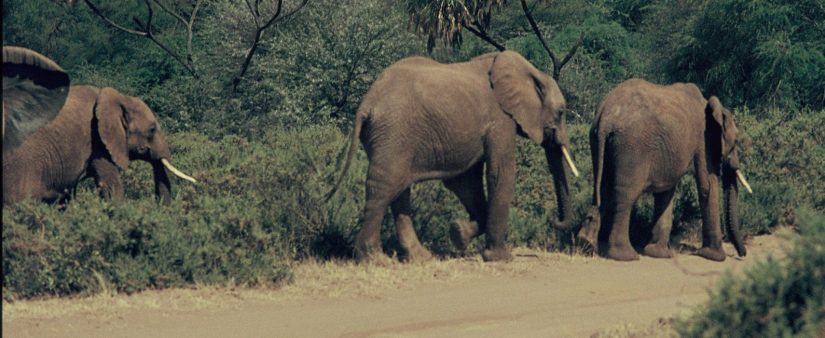
             Amusing jokes, but it’s no joke if you get the wrong side of a real elephant. When I worked in Africa, I was on safari and set off with a pal in his Saab saloon for a ‘game drive’ in the late afternoon. We drove the dusty roads taking in the wonderful wild life until the sun was dropping at about 6.30pm.   

As we headed back toward the lodge, the track wound through a wooded area where we came across a bull elephant tearing at the trees.

          He had his back to us and stood close to the track. We stopped and watched him for a while as he demolished branches, before we decided to move on.

          The engine fired, but the car shuddered and stalled. It was like something was blocking the wheels. Ian opened the window and took a look.

          ‘You won’t believe this. We’ve got a puncture in a rear tyre.’

          We turned to the elephant about twelve feet away. These gentle creatures generally live and let live, that is until distressed. Then the trunk comes up, the ears flap and they charge.

          We were reluctant to turn our backs on him to get down and change a wheel. In the time it took he could have finished dinner and taken an interest in us. The only sensible option was to sit it out until he moved on.

          Ten minutes, sat in a car with the daylight fading can feel a long time. He hadn’t paused his demolition work and there was plenty of foliage left to eat.

          When impatience got the better of us, we got out and crept to the boot. So far so good, he was still noshing. We whispered our simple plan; I would keep watch while Ian started the wheel change.

          My eyes stayed on the dusty giant, but I twitched at each clink of the tools. If he turned, he would be so close we would have to scramble into the car and leave the tools behind. I tried to forget the stories I’d heard of elephants crushing cars.

          A quick look showed that Ian had the wheel off. I took it and hefted it into the boot.  Ian had grabbed the spare and was fitting it on the studs. We froze when the elephant paused and let out a loud sigh. He ignored us as Ian reached for the wheel brace. We were getting there; would the elephant turn and send us scampering before the job was done? 

          I’d aged a bit by the time Ian stood up. We grabbed the kit and threw it into the boot. Slammed the lid and dropped into our seats.

Back at the lodge, bathed in flood light, beside the slow muddy river, we enjoyed a few of the local ‘Tusker’ beers as we told the girls our own Elephant Joke.   

Pic Ken Tracey

Copyright © Ken Tracey 2025

No Puppet

Winston Churchill was born 150 years ago on 30 November 1874. The Royal Mail has issued 8 stamps to celebrate this anniversary. Each bears one of the famous quotes from the great writer and lover of the English Language.  

A few years after Churchill resigned as prime minister in 1955, our English master thankfully chose, (above some tired classics), his autobiography, ‘My Early Life,’ for us to study for ‘O’ Level English Literature. It read like a ‘Boys Own’ adventure with stories of; soldiering for The British Empire, the Boar War as a journalist and escaping from a P.O.W. camp. He’d crammed a lot into his first 25 years. In our mid-teens we wondered what our first 25 years would bring. (Well, there was a disappointing start, when I failed English Literature.) Studying this book changed my view of him from a defunct prime minister to a swashbuckling hero who had problems at school like us 1960s kids.

When I visited his impressive home, Chartwell in Kent, I admired the extensive boundary walls that he had built. He laid so many bricks that he became an accomplished bricklayer and was allowed to join their union. Having found time to watch massive quantities of bricks being laid during my career in the construction industry, I appreciated his hard-won skill.

Appearing in puppet form on ‘Spitting Images,’ is a nod to his enduring popularity and would probably have amused him. Now the show is over and the puppets have been auctioned off, Churchills fetched £1000.

The man himself was no puppet. He was self-confident, powerful, and assertive, traits that made him unpopular with many. He certainly put his stamp on history and in a recent BBC poll was voted ‘The Greatest Briton of all Time.’

He lives on in the form of a puppet in Paul Jackson’s WW2 puppet show – follow the link.

Copyright © Ken Tracey 2024

The Marquis

(Chandos Place, Covent Garden).

Pic Ken Tracey

I was drinking a Czech lager in the space known as ‘Dickens Corner,’ in The Marquis Pub.

‘Dickens,’ because he used to drink here (and everywhere else, it seems). I mulled over his time spent in the nearby Charing Cross area, slaving at the age of 12, in a factory that made boot blacking.  His family were in the Marshalsea debtor’s prison. Like most writers he was; skint, but also absorbing his wretched experiences (like most writers) which he later used in writing ‘Little Dorrit,’ ‘Oliver Twist,’ ‘Nicholas Nickleby’ and so on.     

          You can’t brood on the distant past for too long in this lively pub. My mate Steve introduced me and I regretted that it had taken me so long to get there, I’ve had plenty of time, it has served beer in one name or another since the 1600s.

          The small bar is typical of a London boozer, with a good selection of beers, so that’s a plus for a start. Dylan growling ‘Positively Fourth Street,’ gave some drinkers ‘a lot of nerve’ to sing along. I gave the pub a double plus for the great music, but the best was hissing gently behind the bar.  

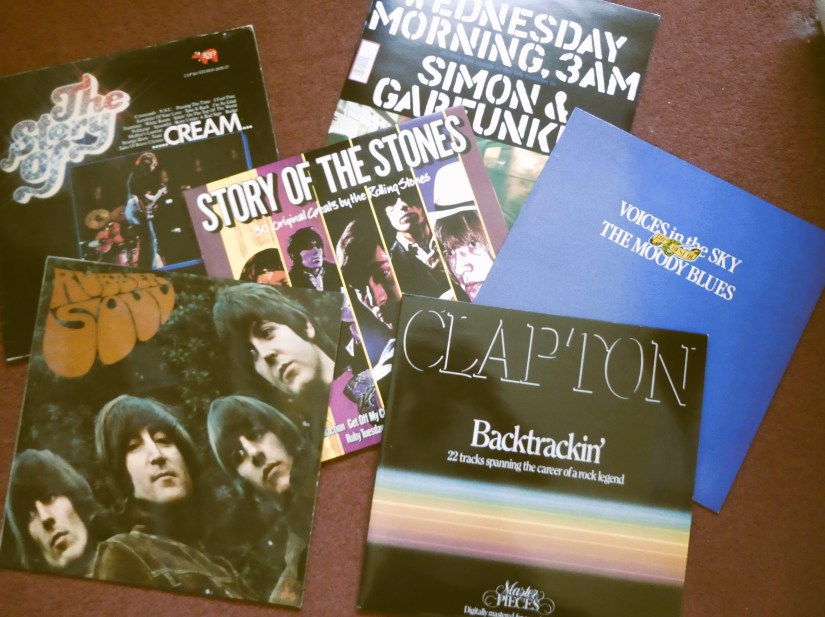
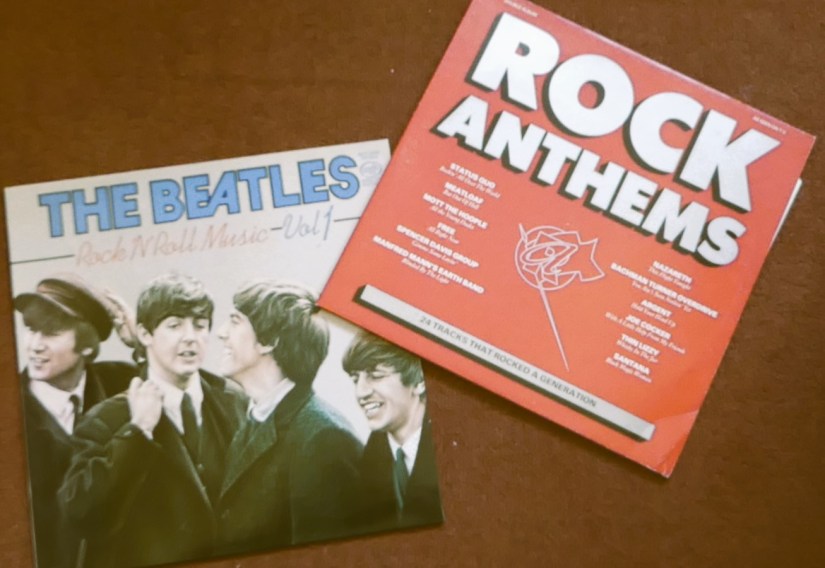
          We were served by, ‘The Girl from Ipanema.’ OK. I’m in a musical mood, but she was from Brazil and ‘young and lovely’. It was then that I noticed that they were spinning vinyl records. Bob Dylan’s Greatest Hits was on the turntable and the back bar was stacked with vinyl albums and 45s. Customer’s requests were welcomed.

          When the stylus lifted from Bob’s tones, I left the ‘Corner’ to make my request. We had enjoyed a few tracks of ‘Sergeant Pepper’s Lonely Hearts Club Band,’ and a beer or two, when a guy walked in with a guitar case hung over his shoulder and joined a group at the bar. He wouldn’t have looked out of place on the sleeve of a late Beatles album. Big hair, moustache, jacket and tinted specs, obviously a performer.  

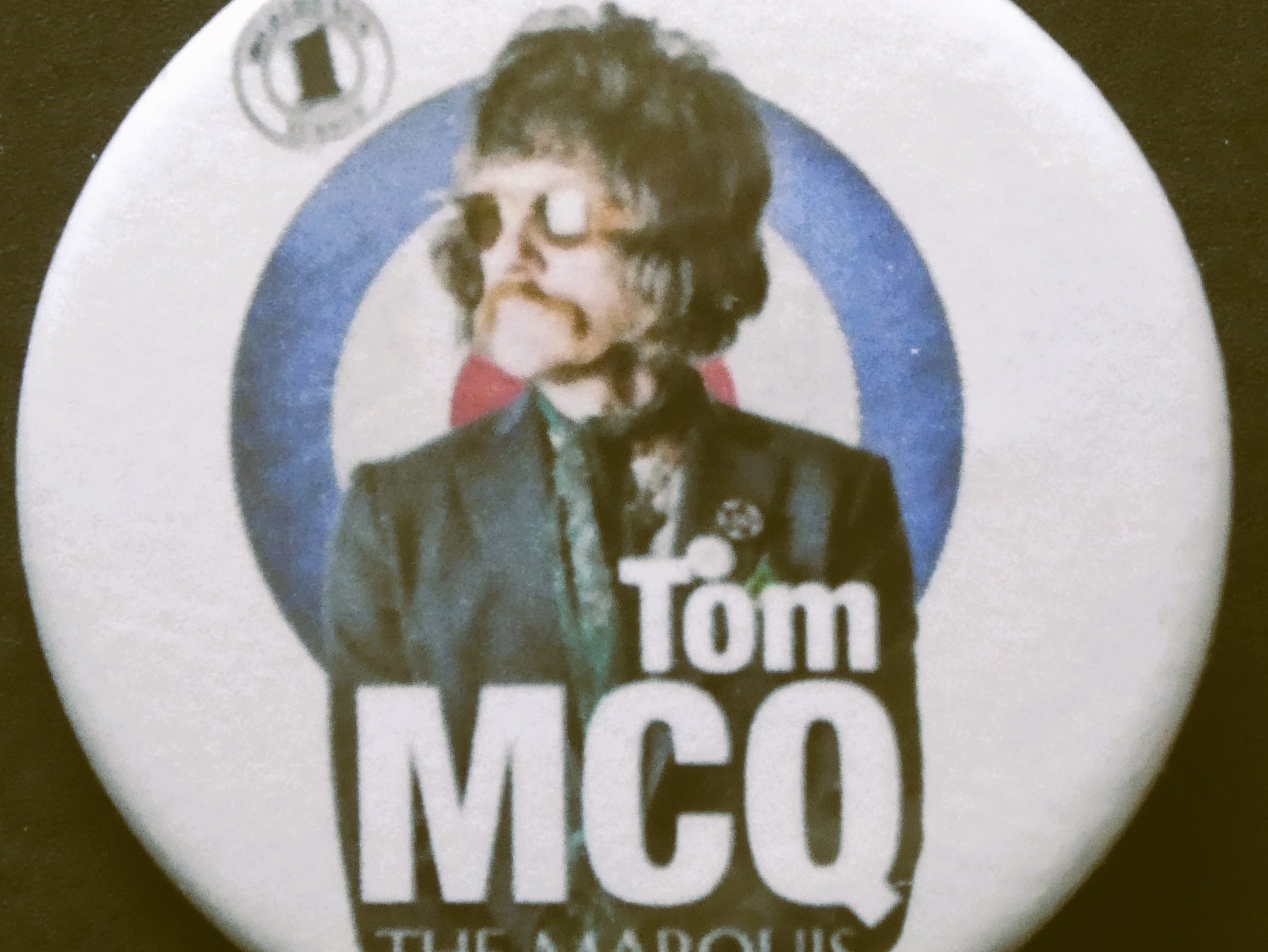
          The bar is small and friendly so when I bought the next round we got to chat. He was Tom MCQ, a resident act at the Marquis; busker, storyteller, poet and singer-songwriter. He picked up my scouse accent, so that sparked off tales of my youth (misspent, but not much snooker) growing up to the Beatles sound, our local band. ‘Saw them 100s of times for about three shillings a time.’ (15 pence to our younger readers) And all that! When we shook hands I said, ‘Shake the hand that shook the hand of John Lennon.’ He liked it and so did the Girl from Brazil who took our picture. Tom then gave Steve and I his P.R. badges.

          With our last drink Steve requested the Rolling Stones. The rocking, ‘Get Off My Cloud’, brought the drinkers to their feet, singing and calling ‘Hey You,’ to each other. A pleasure to be there, a great atmosphere with a friendly happy crowd and staff and of course great vinyl.    

As we left Tom MCQ said that, ‘Shake the Hand that Shook the Hand of John Lennon,’ sounded like a song title. Wow!

Pic Ken Tracey

Copyright © Ken Tracey 2024

The Confession

by John Grisham

See my review on the ‘Book Review’ page.

Donte Drumm is a black schoolboy whose graduation and promising future as a football player are quashed when, at the age of fifteen, he is arrested for the rape and murder of a white cheerleader. An horrendous situation to be in, especially in Texas.  

Mr Gandy’s Grand Tour

by Alan Titchmarsh

A new review, see the ‘Book Review’ page.

The sudden death of his wife, Isobel, releases Timothy Gandy from a long and two bedroomed marriage. Retired in his mid-fifties, he can now indulge in a Grand Tour of Europe, shadowing the rich of centuries past. He travels but can’t leave his family ties behind.

More than a Joker

Jeremy Beadle, the TV prankster who died aged 59, would have been 75 this month. He caught the attention of TV viewers in the 1980s as one of the presenters of ‘Game for a Laugh,’ a show involving practical jokes on unsuspecting folk, a specialty of Beadle’s who was always up for a ‘lark.’

This made him popular and a huge success, but unpopular with some. However, Jeremy wasn’t just a joker, read more in my article from ‘Life in Orpington / Bromley’ magazines, page 42, via the link below.  

https://www.lifeinmagazines.co.uk/latest-issue/ April 2023 issue

Just a few words…

Flash Fiction or the short-short story is popular with writers now. Lengths vary between competitions but are generally less than 1000 words. It’s a skilful process to tell a tale with such brevity.   

Through Writers Forum magazine, I discovered the Fusilli Writing website and although almost a stranger to ‘Flash’, decided to have a go. My first attempt was short-listed (September 2022.) please see below.

It’s a rewarding process so, have a go.

  • Visit- fusilliwriting.com
  • Maximum word count is 200.
  • The theme is open but must have a twist ending.
  • Entry is free-so nothing to lose.
  • There are no prizes, but the winner of each comp. is published on the website. Shortlisted entrants get a mention.

Tap into your imagination.

My attempt- 

Pawn to Knight

The last day before the school holidays. There were no lessons so the boys brought board games, record players and all sorts of stuff. I swaggered in with my guitar over my shoulder. ‘Haven’t you got a case for that, Elvis?’ Funny comment from the usual big mouth. 

          A small group gathered around me when I started to play, clicking their fingers and stumbling over the words. My heart sank as one by one they drifted off to play games or to listen to Cliff or Eddie Cochran records. I was having trouble with ‘Johnny B. Goode,’ so went out into the corridor to practice. 

When I got back, they’d settled down, there was a chess tournament going on and the PE teacher had come in to control us.

‘I’m back fans,’ I said as I climbed on a desk. It felt great looking down on the small crowd and it made me play better.  

          ‘Shut up, we’re trying to play chess here,’ he was joined by a chorus of ‘shut up’ from the rest of them.

          The teacher butted in too. ‘Get off the desk McCartney and do something worthwhile instead of making that noise.’

Copyright © 2023 by Ken Tracey

(196 words)

‘It Doesn’t Matter Anymore’

A lifetime ago on 3 February 1959 the private plane carrying Buddy Holly crashed in Cerro Gordo County, Iowa killing Buddy and two other touring musicians.

Buddy, 22 years old, was a rock and roll pioneer, he was the first to write his own songs. 17-year-old Ritchie Valens and 28-year-old Jiles P Richardson who performed as ‘The Big Bopper’ had hits in the charts and died too. The pilot Roger Peterson also perished.  

Buddy, from Lubbock Texas, was survived by his wife of 6 months, Maria Elena Holly. She was pregnant and miscarried a day after the crash due to the trauma.

He had many great hits including;’ Oh Boy’, ‘That’ll Be the Day’, ‘Peggy Sue’, ‘Rave On’, ‘Every Day’ and the haunting ‘True Love Ways’. Songs loved to this day and the inspiration to many great musicians including the Beatles.  

Ritchie wrote the hit song ‘Donna’ for his girlfriend Donna Ludwig. It was a great single with the ever popular ‘La Bamba’ on the flipside. 

The Big Bopper wrote his novelty hit, ‘Chantilly Lace,’ depicting a cheeky phone call from a boy to his girlfriend.

A generation of teenagers were overwhelmed by the loss of Buddy at the peak of his career. It was hard to accept that this was the end of Buddy Holly songs. In fact, there were others released posthumously; ‘Brown Eyed Handsome Man,’ ‘Peggy Sue Got Married,’ ‘Midnight Shift,’ etc.

I was 14 years old and delivering the morning papers when I heard the news. You can imagine my feelings of de javu 12 years later when Don McLean depicted this very scene in his 1971 song ‘American Pie,’ about the death of Buddy’s music. Perhaps teenagers all over the world were delivering papers that morning.

At school we were irritated by our teachers saying, ‘Who is Buddy Holly?’ and gravitated in awe to the one boy in the school who had seen Buddy live at the Liverpool Philharmonic Hall in 1958. The boy’s fame lasted until we left school to start work years later.   

Soon after their tragic deaths a tribute song to the musicians, ‘Three Stars,’ was released. A tear jerker about three bright new stars in the heavens and how we would miss our heroes. When it was played on juke boxes, sobbing girls had to be carried out of coffee bars. Then along came the last song to be released in Buddy’s lifetime, only a few weeks before his death, written by Paul Anka, about the end of a relationship, with the ironic title- ‘It Doesn’t Matter Anymore.’       

Copyright © Ken Tracey 2023