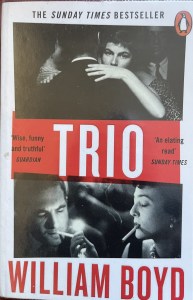
‘Trio’ by William Boyd
Don’t be put off by the first page of this interesting novel. It’s a slow opening that describes the early morning blues of an alcoholic that we haven’t met yet and therefore care little about. After an aspirin and a gulp of fresh air, I read on.
In 1968 the three main characters are drawn to Brighton to make a film, however there is plenty of drama in their own lives. Elfrida’s husband works on the production, while she is on the road to alcoholic hell, with good intentions. A successful author, likened to Virginia Woolf, she has tolerated writers block for ten years and now plans to break out with a novel drawn from the last day in the life of Virginia Woolf. She becomes obsessed with rewriting the first page. Her booze problem doesn’t allow her to move on, or even think that the project may not be realistic. She needs a solution that will take her away from; writing, the drink and a philandering husband.
Talbot is a film producer, a middle-aged married man with two children whose role includes dealing with; theft, extortion and a missing star actress. He leads a cautious private life unable to grasp the new freedom granted by the recent decriminalisation of homosexual acts. He is edgy visiting a gay club and secretly owns a maisonette which houses his dark room for producing photographs of male models, which are kept under padlock. He is haunted throughout by the lyrics of the 60s hit ‘MacArthur Park,’ a great reference to the times. After the attempted treachery of his business partner, he finds a way out.
Anny, the pill popping American star of the film, is in her late twenties. (I read ‘Amy’ well into the story, the double ‘n’ merging each time I saw it!) Her affair with Troy the male star is interrupted by a visit from her French boyfriend. The lady gets busier and is horrified by the appearance of her ex-husband pursued by the FBI due to his terrorist activities. He persists in visiting her and things get tricky, so she has to find a way out.
I enjoyed the difficult situations served up to the three characters, but the conclusion to both Talbot’s and Anny’s problems came across a little bland.
‘Trio’ turned out to be a compelling and enjoyable read and I found a new author to follow. I’m now looking forward to reading ‘Restless.’
Copyright © 2025 Ken Tracey
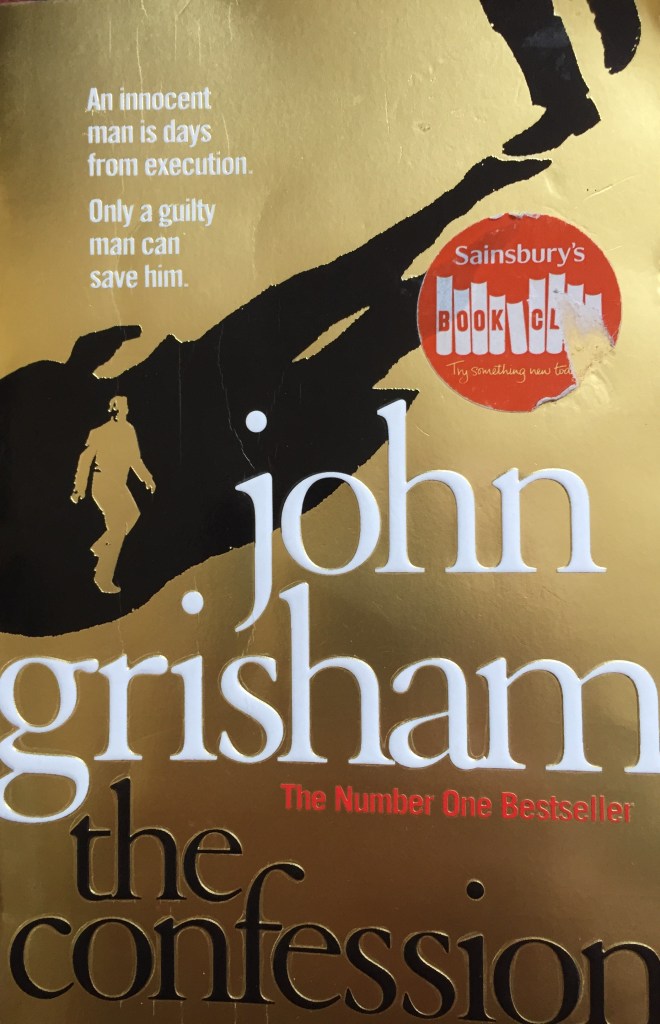
‘The Confession’ by John Grisham
Donte Drumm is a black schoolboy whose graduation and promising future as a football player are quashed when at the age of fifteen, he is arrested for the rape and murder of a white cheerleader. An horrendous situation to be in, especially in Texas.
Donte denies knowledge of the murder and the prosecutors lack physical evidence, as the victim’s body has not been found. We learn that the police, frustrated by their lack of evidence, go to work on the teenager and employ prison ‘snitches’ to help extract a confession from him. Soon a witness steps up putting Donte, driving a van close to the time and place of the girl’s disappearance. Job done; the police don’t need evidence from the body and its whereabouts remains a mystery.
Donte is represented by Robbie Flak a hard lawyer skilled in theatrical posturing and as the tale unfolded, he became likeable. Flak fails to win Donte’s case, but convinced of his innocence, he relentlessly supports the teenager and pursues many appeals against his murder conviction. During this time, Donte is incarcerated on death row for some nine years.
The legal process is exhausted and an execution date is set for Donte. Four days before and hundreds of miles away in Kansas, a serial rapist on parole, walks into a church office and admits to the minister, Keith Schroeder, that he raped and murdered the Texan cheerleader and that he is prepared to confess publicly and reveal where he buried her.
Keith is conscious that he could save an innocent boy from execution, but to do this he’d have to act quickly and break the law himself by driving Travis out of state to Texas. There is also the possibility that the habitual criminal is lying to get attention for his own ends, and that the officials will be reluctant to admit that their conviction of a black boy is not safe. The minister must be guided by his conscience and find a way to tackle these obstacles and perhaps save Donte from death.
His actions and the reactions of those in power make for compulsive reading of this tale. Throughout a case is made against capital punishment and the state officials who support it.
I enjoy John Grisham’s novels, but it became a task to reach the end of this one, despite the compelling plot, the worthy topics tackled, his expert knowledge of legal procedure and as always, his excellent writing. The story was hampered by its excessive length, deviating from the main action to provide detail of incidents that the reader was already aware of, or scenes that had little bearing on the conclusion. To the books credit, I didn’t cast it aside, I read it through.
Copyright © 2024 Ken Tracey

‘Mr Gandy’s Grand Tour‘ by Alan Titchmarsh
The sudden death of his wife, Isobel, releases Timothy Gandy from a long and two bedroomed marriage. His son and two daughters are independent and he has an uneasy relationship with the elder two, favouring his understanding daughter Rosie, the mother of his only grandchild, Elsie.
Retired in his mid-fifties, he can now indulge in a Grand Tour of Europe, shadowing the rich of centuries past. A desire he has concealed for years. Strangely, it appeared that Tim had no experience of foreign travel.
First stop is Paris, but there isn’t much culture to endure, Alan Titchmarsh’s plotting is full of surprises and the first is a meeting with the lovely Francine during a visit to Versailles.
Tim’s new life had prompted him to return to drawing and watercolour painting. Francine, a gallery owner, compliments him on his pictures of the Palace and they become good friends. He visits her gallery and moves into an hotel that she recommends. I was beginning to think the tour would come to an abrupt end here, with Tim moving in with Francine and becoming a source of paintings for her gallery. Instead of this blissful denouement, she urges him to follow his dream. The significance of this is revealed at the end of the story. He leaves with a promise to return.
In Monaco he broods about his children and their divided lives and suffers guilt about his success with Francine. The maudlin scenes are banished when he meets up with Archie, an upper class salesman selling expensive yachts.
They share their plans and family problems and dispatch a pair of thieves from a yacht. Archie’s Aunt Rosamund, a resident of Monaco, encourages Tim to continue his tour and they too share anxieties about their families.
On to Florence and another surprise encounter and more family matters from this well plotted story. His last city is Rome and we wait to see if this complicated man will satisfy us with a return to Paris and Francine.
Throughout the story his children are a concern to him and their magnate draws him off course. This was a bit dull at times.
This was an enjoyable read when I’d adjusted to his name and dispelled visions of Mahatma Ghandhi from my mind.
Although in his mid-fifties, he often acted older than his years, as if his life was nearly over, more like a man in his seventies.
The emotional ending is good and satisfying.
Copyright © 2023 Ken Tracey
‘London Burning’ By Anthony Quinn
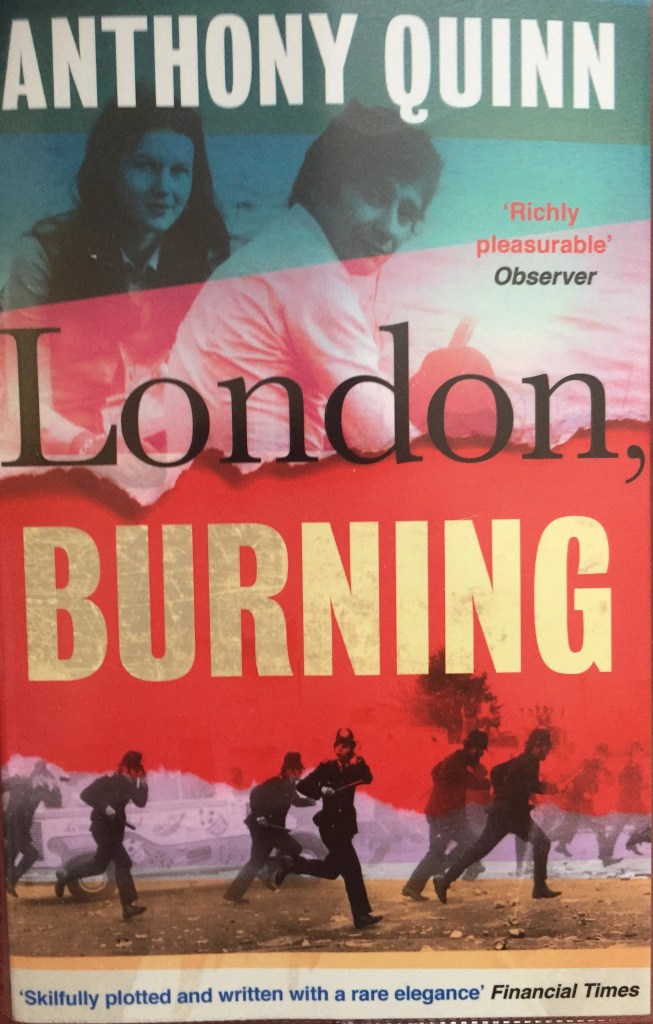
The backdrop of the 1970s gives added interest to this tale. Strikes, demonstrations, murder on the streets, police corruption and a shaky distrusted government. The wheel keeps on turning, this could be 2023.
There are four strands to the story and encountering each one in isolation was baffling as to how they would link up.
Vicky an undercover cop, is taken into the confidence of a senior officer who is concerned about corruption in the Metropolitan Force. She is cut in on a share of confiscated drugs money by a colleague. Although distasteful, she has to accept it to keep close to the ‘boys.’ This is the basis of a good standalone story. But there is more.
Callum, from Ulster, now teaching literature in London, meets Martin, a friend from university, who is working with the shadow government (Conservatives). Callum invites Martin to lodge in his flat on the nights he stays in London. Through Martin he rubs shoulders with the shadow Home Secretary, a character based on the murdered politician, Airey Neave. This association and his meeting with a mate from back in Newry have wretched results for Callum.
Hannah is a journalist on the left-wing Ensign and covers stories about Northern Ireland. When her blind date does not turn up in a pub, she encounters a character from another strand in the plot and plays an important part in his survival.
Freddie has a working-class background, is middle aged and into his mid-life crises. A successful director, he has the adulation of the theatre set. His latest venture is a musical of the ‘Ragged Trousered Philanthropists,’
These four strands are expertly twisted together by Anthony Quinn to form a fascinating tale. It is a good story and would be of interest especially to those who lived through the seventies. The music references include my favourite line from Bowie’s ‘All the Young Dudes.’
I was disappointed with the sudden ending and would have liked a firm conclusion to some of the storylines, in particular the police side of the story.
Copyright © 2023 Ken Tracey
‘Tunnel 29’ By Helena Merriman
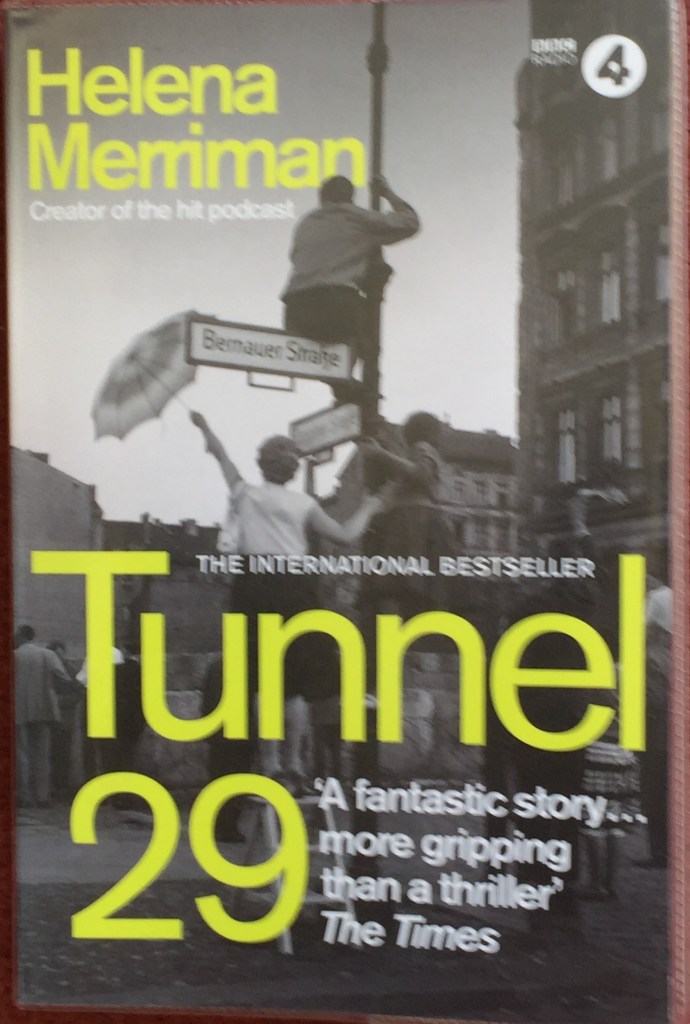
I chose this book thinking that it was a thriller but later realised that it was tagged ‘History.’ It worked on both levels; an informative account of the scandalous German Democratic Republic and The Berlin Wall. Also, a tense journey with the young people who gave a chunk of their lives to gruelling work under the risk of torture and death to help strangers to escape to freedom.
Joachim Rudolph, the hero, was twenty-one in 1961 when Berlin was divided by the Wall. He and his family were restricted to living in East Berlin, but as West German passport holders they could visit the West to buy produce unavailable at home. The border was heavily guarded by the Volkspolizei (VoPos) who shot dead East Germans attempting to escape.
The Ministry of State Security (Stasi) a regime of fear, spied on the population aided by masses of civilian informers who reported escape plans to them. Those involved were imprisoned, tortured and murdered. Joachim made a daring escape across the border with a friend and settled in West Berlin.
Family and friends left behind by escapees received callous treatment from the Stasi, so Joachim, an engineering student, devised a scheme to rescue such people. As escape over the Wall had become almost impossible, he used his engineering skills and planned to dig a tunnel from west to east.
The practical problems of the project were immense but the will and ingenuity of the diggers paid off. Failure brought disappointment which led to replanning and eventual success.
Helena Merriman tells the enthralling story of real people. It was an additional pleasure to see the photographs of the places and the heroes involved.
The last chapter, ‘What They Did Next,’ was particularly moving. because these people were young, and had a lifetime after these events. Our hero married a colleague on the team and they were still living in Berlin at the time the book was written.
Copyright © 2022 Ken Tracey
‘The Reckoning’ By John Grisham
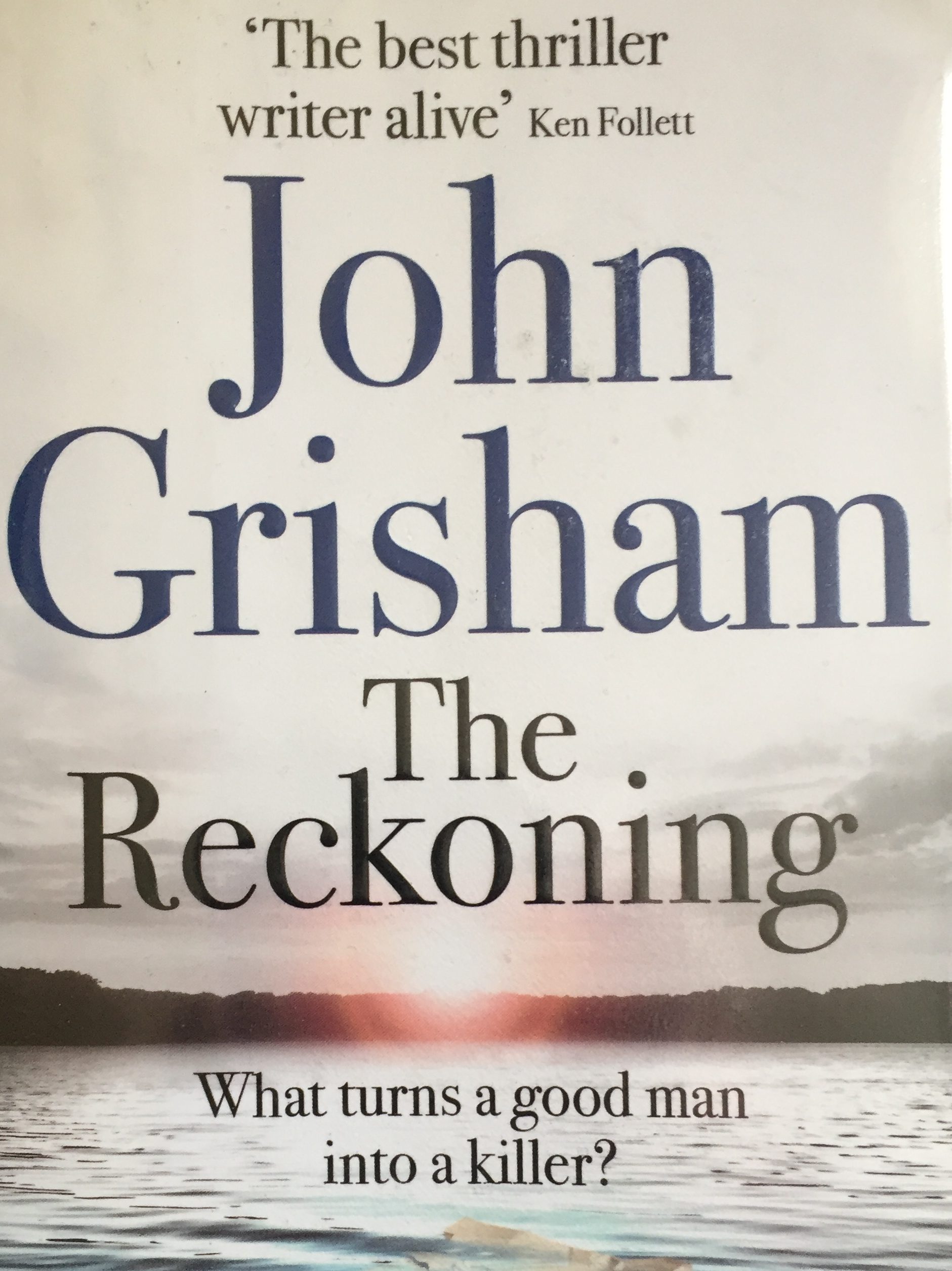
It’s always a good tale that raises an intriguing question in the first chapter and doesn’t give an explanation until the last chapter- in this novel that’s a hefty 500 pages on. I was compelled to press on until my curiosity was sated.
Pete Banning, a respected Methodist, cotton farmer, war hero, husband and father, lives alone. His wife, Liza has suffered a breakdown and is receiving mental care in an institution. He rises from his bed one morning in 1946, drives in to town and coolly shoots dead his preacher, Dexter Bell. If that is not surprise enough, he then makes no attempt to escape, instead he directs a witness to, ‘Go tell the sheriff.’ Pete is arrested and the intrigue piles up when he refuses to explain why he murdered the good preacher.
Grisham sets the story in Clanton, Mississippi, and it started as a comfortable read in that setting familiar to his readers. Pete gets a defence lawyer but will not offer any information for the construction of his defence. The court proceedings and lawyer dialogue are, as always, with JG sound authentic and interesting.
At trial, Pete is found guilty of murder which is the only possible outcome due to his refusal to cooperate with his own lawyer. Inevitably in that time and place he suffers the death penalty. So, the first part of the novel closes. There are three parts.
Part Two flashes back to Pete meeting his wife Liza, the ideal couple’s marriage and the birth of their children. But soon there is a sharp turn and the story moves to Pete’s wartime service in the army.
We leave the sunny southern states for an horrific war story set in the Philippines. The contrast disrupted my enjoyment and I was tempted to abandon the book. This part covers some 140 pages. Pete goes to hell and back, an experience that changes him. The effect of his harsh treatment by the Japanese could have been described without such a long deviation in the plot.
During his long absence from the farm, he is reported as missing probably dead, an important factor to the plot and the subject of obvious surprise when he does return home.
Part Three returns to The South and an investigation by the couple’s children Joel and Stella into their parent’s history. Alongside this they suffer for the sins of their father. There is a lot of pointless travel to and from their colleges and holiday destinations which prolongs the story further.
Eventually we reach the partly surprising answer to the question as to why Pete murdered the preacher.
It now seems to be a trend for novels to be bulkier than their stories require.
Copyright © 2022 Ken Tracey
‘Our Friends in Beijing’ By John Simpson
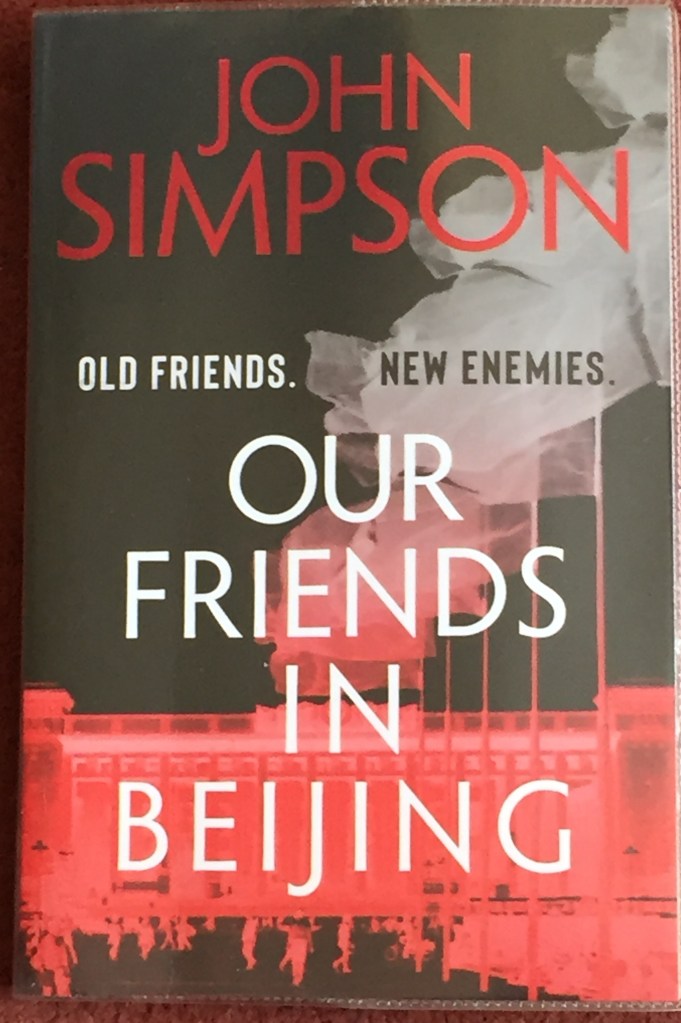
The story opens with action where the hero is being interrogated in his own home and is left bleeding on a good carpet.
Jon Swift a globetrotting TV journalist, features in an earlier novel by John Simpson, but this new tale, published in 2021/22, can be enjoyed independently of the first.
Swift is suffering the discomfort of the middle-aged employee when the ‘Tick Box Charlies,’ take over the management of his organisation. It’s made clear, by his young manager, that despite his knowledge and experience he will take a walk to the door before long with a cardboard box under his arm.
He encounters Lin Lifeng, an old buddy from the 1989 Tiananmen Square protests, in his favourite café in Oxford. Lin has climbed the ladder and holds an important position in China. He realises that the reunion after so long is not by chance when Lin asks him to deliver a coded message.
Swift then reasons that a big story is about to break in China around Lin Lifeng and wangles a trip there. The story might be his swansong but, if it’s as big as he suspects, it could save his job.
He takes along Alyssa, his attractive assistant and tries hard and often to coax her into bed. Her constant rebuffs provide comical exchanges between the couple.
He travels back and forth across China in search of his story. Distracted and diverted by government spies, agents, double agents and politicians. He unearths the huge political story and an illegal business run by Lifeng. Without spoiling the political denouement, it lacked impact.
Simpsons first-hand knowledge of China and its politicos gives the tale reality, we are told that the ‘wet markets ‘have been around long before the batty COVID excuse. I liked the self-critical, yet determined Swift. However, it was not an easy read, the plot is complex and I felt the story would have benefitted by fewer words.
Copyright © 2022 Ken Tracey
‘After the Fire,’ by Henning Mankell
If you are young enough to be baffled by a grey-haired man wearing odd wellington boots, or you are reading this while trying to remember why you came into the room in the first place, either way Henning Mankell’s character Fredrik will give you a wonderful insight to the elderly mind. This is the continuation of his story from the novel, ‘Italian Shoes,’ but stands alone, satisfying without reading the first one.
Mankell, best known to crime readers for his Wallander detective series, in this his final novel, ‘After the Fire,’ takes us to a fictional archipelago off Stockholm, Sweden. Where retired surgeon Fredrik Welin lives alone on a small island inherited from his grandparents and drenched in memories from his own early years.
He regularly visits a larger island in his boat for supplies, and on one occasion to order Swedish wellington boots which are often in his thoughts, but don’t make their debut until near the end of the story.
His choice of the lonely life, in part, is a need to distance himself from a surgical error involving the amputation of a patients arm and leading to his own retirement.
Human contact is restricted to his hypochondriac postman, Jansson, who reads the islander’s mail. He is generous, transporting Fredrik, when necessary, back and forth in his boat, and in return takes advantage of the medic’s skills to check his aches and pains and blood pressure. His other human contacts are the traders across the water in the town’s stores and café and Rut Oslovski, a lady who is rebuilding a classic car and allows Fredrik to keep his car on her property.
His house has burnt down during the night and Fredrik has escaped. The police inspection points to arson so, soon Fredrik is suspected as the culprit, which is not surprising on an island populated by one.
He moves into the caravan his 40-year-old daughter, Louise uses on her irregular visits. He was unaware of her existence until late in life and they have a distrust of each other. Not helped by her unannounced arrivals and departures and long absences. She is a political activist and has stripped naked in front of politicians to make a point. She returns to the Island on hearing about the fire, but soon disappears without explanation.
Lisa Modin, a journalist on the local paper visits to cover the story of the fire. Fredrik is soon speculating about having a relationship with the younger woman and invites himself to her home at night. She allows him to stay, sleeping on the settee. Intrigued by her, he searches her possessions while she is sleeping and uncovers a family secret.
Lisa is interested in establishing the cause of the fire and pays visits to Fredrik’s Island. Although there are several sleepovers, the complicated pair don’t rush into a relationship.
Fredrik is troubled by a number of incidents; flashing lights at night, the unexplained absences of Rut Oslovski from her home, evidence found of an unknown camper, his missing watch and the sudden deaths of local people. Has he become insane and burnt his own house down as the police suspect?
Louise calls him from Paris where she is in trouble with the police. Fredrik travels to help her and learns that she lives there with a partner. They warm a little to each other and discuss re-building the house, when the insurers pay up. Lisa Modin joins him in Paris and they learn of another house fire back on the archipelago. Further fires break out, but in the small cast of characters the reader can find few suspects.
Eventually all the strange happenings are resolved.
With most of his life behind him, the physical appearance of present-day people and places remind Fredrik of people and things that went before. A lady shopping brings on thoughts of an old lover and his regret at the way he treated her. These flashbacks are seamlessly wrought into the story by Mankell and didn’t stall the yarn, but enhanced my empathy for the appealing character.
The harsh climate is portrayed with relentless images; Fredrik taking his daily dip in the freezing seawater, Harriet, Louise’s mother pushing a Zimmer frame to walk across the frozen sea. The weather also marks the passage of time; ‘It was the first night I’d worn socks in bed.’
Unlike the Wallander novels this is not a crime story, although born from arson. It will appeal to readers who enjoy a more literary work.
Henning Mankell died of cancer at the age of 67, in 2015, the year the book was published. Fredrik’s story must give an insight into Mankell’s own closing thoughts.
Copyright © 2021 Ken Tracey
‘Earthly Remains’ by Donna Leon
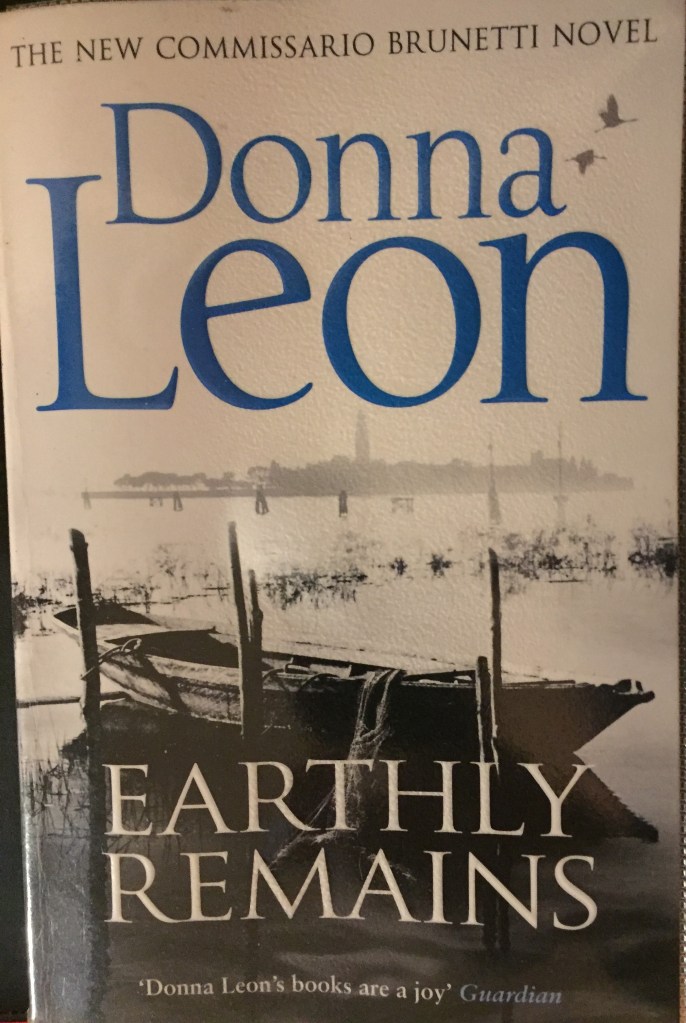
This is the first Commissario Brunetti novel I have read. Donna Leon’s series came highly recommended to me, I see that this one is late in the series and possibly beyond the work that was recommended.
During the interrogation of a lawyer suspected of causing the death of a young woman, a fellow officer’s manner warns Brunetti that his colleague has lost patience and is about to strike the suspect. Brunetti implausibly fakes a heart attack to draw the attention of the other two men.
His ruse works, saving the officer’s career. Brunetti then faces a medical examination and is found to be in good health except for high blood pressure. A doctor puts this down to exhaustion and the tables are turned when she recommends, he take sick leave from his stressful job.
Not what Brunetti expected, but to retain his credibility and to mull over his doubts about his future in the police, he takes the break. Alone he sets off to stay in a family property on the Isle of Sant Erasmo. So, the scene is set for a mystery in a lonely place and sure enough one develops.
To combat his stress, Brunetti accepts the invitation of the resident caretaker of the property, Casati, to join him rowing his ‘paparin’ around the canals and laguna of Venice.
They spend days rowing and bonding, these scenes reveal a problem, crucial to the plot, but slow down the pace.
Casati keeps bees on the islands and is saddened by the unexplained death of many of them. He collects soil samples for laboratory analysis. By now the clues point quite correctly to an environmental story.
During a swim, scars are revealed on Casati’s body, which he does not explain, they turn out to be significant to the plot.
The gentle days are shattered when Casati goes missing. The recuperating detective is driven to find him. The veteran sailor has drowned, pulled under by the anchor rope of his vessel. Brunetti in grief speculates whether it’s an accident or in light of their recent conversations, suicide.
He taxis back and forth across the laguna to interview Casati’s family and colleagues from his working days. An event from his past answers the questions raised.
The conclusion hints that Casati was murdered, there is no evidence and a helpful clue is destroyed by tidy police officers. There is also the suggestion that some well-connected people are not affected by the law.
The conclusion is abrupt and unclear.
Copyright © 2021 Ken Tracey
 Ken Tracey