I shelved this book after reading a few chapters, bogged down by the old and alien language used but, I was only 9 years old at the time. It was a present from Aunty Dora who also gave me; ‘The Adventures of Tom Sawyer,’ and ‘The Adventures of Huckleberry Finn,’ both also abandoned until later life. Her efforts to introduce me to the classics weren’t wasted, I whizzed through, ‘Black Beauty’ and ‘Coral Island’ and remained a book reader for ever.
So why did I choose to read this children’s story decades later (lots of them), after having lost my copy of the book somewhere in life’s rich pattern?
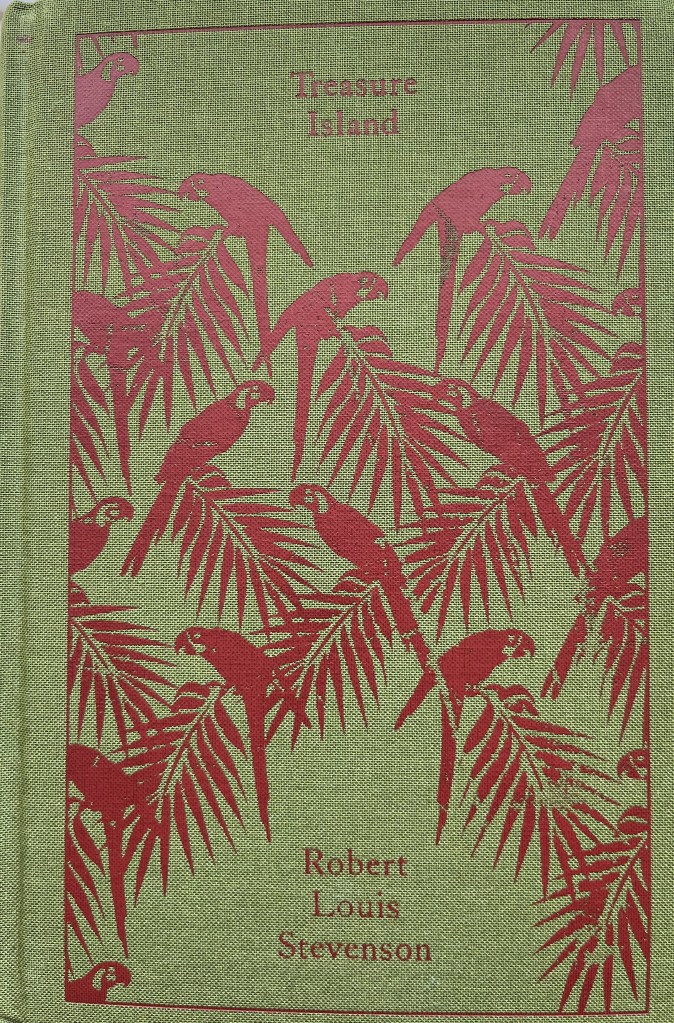
It was while reading the fascinating ‘Spice,’ a history of the spice wars by Roger Crowley, that the buccaneering tactics of the explorers blew a fresh breeze into my memories of, ‘Jim lad,’ and that parrot’s perch, ‘Long John Silver.’ The libraries appear to have deserted the ‘Island’ or buried it in far off archives, so I bought a copy. A hard back (Penguin Classics) the board cover impressed with multiple silhouettes of Captain Flint who you must remember was Silver’s parrot (Attractive cover designed by Coralie Bickford-Smith).
Stevenson’s straightforward linear plot was less complicated than my recollections based on the earlier scant reading and the superb comic strip version in the 1950s ‘Topper’ comic.
The sea dog’s language was difficult to interpret at times and the refined lines of Dr Livesey and Squire Trelawney went on a bit, but it does build the 1700s characters and setting, and doesn’t block progress through the story.
While Jim is out of sight, scrumping apples in an almost empty barrel he overhears the rebel crew members plotting to take over the ship and treasure. He must pass on this warning, picked up in his apple device, to the Squire and officers. So begins the mutiny.
The youthful and competent narrator, Jim Hawkins, bears the brunt of Stevenson’s incessant conflict and succeeds against the odds even to snatch the schooner, Hispaniola backfrom the pirates.
It’s a tale of good over evil. Pre-story: the greedy Capt. Flint plundered a mass of treasure and buried it, but cut his crew members out of their shares by killing them. Didn’t do him much good, he died and only had a parrot named after him! The mutiny of the crew, led by Silver is inspired too by greed, so that the buccaneers have the treasure for themselves.
The odyssey was triggered by the discovery of a map of Treasure Island in an old sailor’s trunk, left at the family inn of Jim Hawkins. Crosses on the map showed where the treasure was buried.
Appendix A: ‘My First Book’ (1894) by Stevenson himself, tells that it was the unusual prompt of a map that motivated him to write Treasure Island. To entertain a schoolboy lodger during his school holidays, Stevenson showed an interest in the boy’s passion for painting, producing some pictures of his own. Fortune brushed his paint into the shape of an island which he proceeded to decorate with features and place names. He treasured his creation and became obsessed with the place which he then brought to life by writing the story.
I needed a clearer map than the one illustrated in the book, to track the adventurer’s paths around the place. I suspect the map published is a faithful reproduction of Stevenson’s map.
Having had some knowledge of the plot already, I was surprised at the brief appearances of Ben Gunn and the parrot.
After reading I was still mystified as to what, ’15 men on a dead man’s chest’ meant. It was the internet that revealed that: the sea shanty refers to Dead Chest Island, where the pirate Blackbeard marooned 15 mutineers. Not part of Stevenson’s story.
I enjoyed the read that was straightforward and surprisingly quick being less than 200 pages.
Now, I’m pleased that I got through writing this review without repeating ‘Pieces of eight! Pieces of eight!’ oh darn, I just d…

